Need to reach your wall or roof from next door? Get access agreed
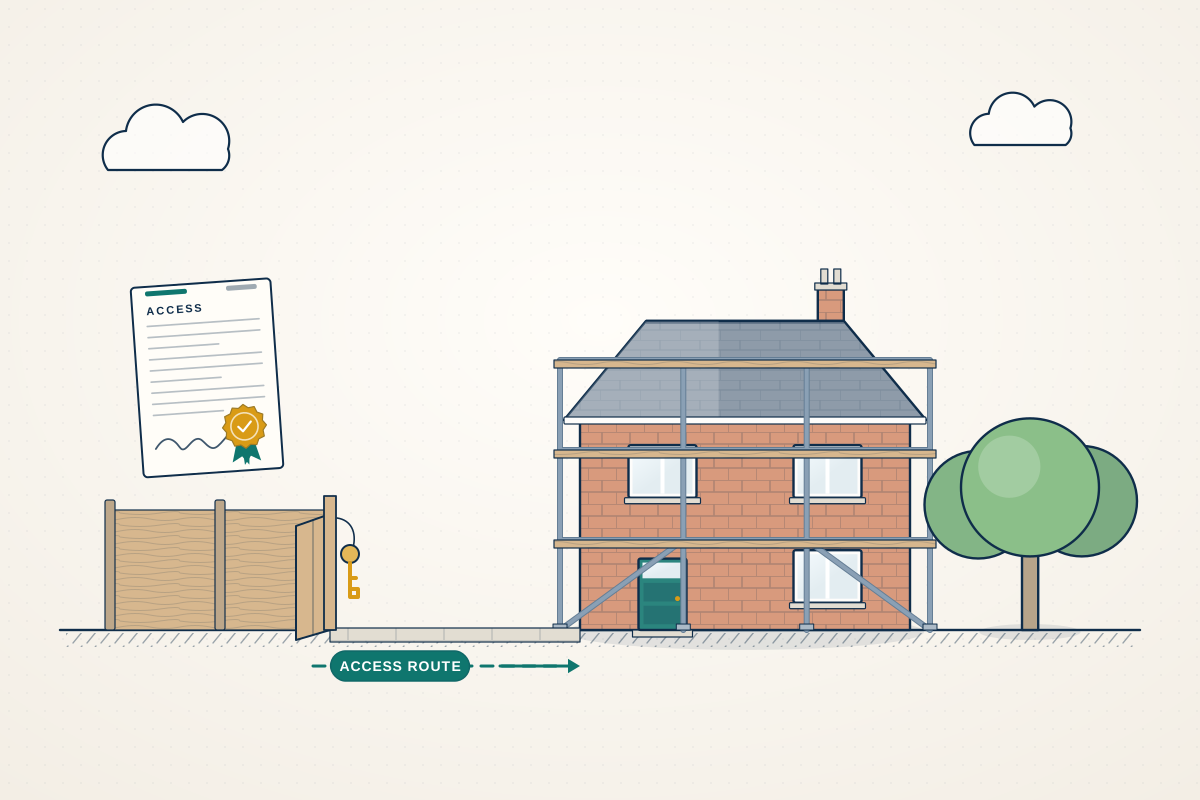
For homeowners and builders who need access across or onto next door’s property, and for neighbours asked to allow it. Compare quotes from surveyors who arrange access agreements.
Scaffolding often has to stand on a neighbour’s side of the boundary. A roof edge or wall may only be reachable from next door’s garden, or builders may need room to work. Going onto a neighbour’s land without permission can amount to trespass, so the first step is a friendly request, followed by a written agreement. If the work is covered by the Party Wall etc. Act 1996 in England and Wales, the Act gives building owners a right of entry after notice, for the work it covers. For some basic repairs a court can order access. A surveyor explains which route fits your job and sets out sensible terms.
How a professional can help
- Working out what access you actually need: They look at the work and your builder’s method to define exactly what is needed: where scaffold legs stand, which route the builder walks and for how long. A small, clear request is easier to agree.
- Approaching the neighbour: They help you write a clear, courteous request with a plan and dates, and can talk to the neighbour’s surveyor or agent. A neighbour is more likely to agree when they know what is happening and for how long.
- Drawing up an access agreement or licence: They set out the area, dates, working hours, insurance, protection for plants and paving, and how the ground is left afterwards, so both sides know what was agreed. A solicitor can turn it into a formal licence, which is written permission to enter.
- Using the party wall route: Where the work falls under the Party Wall etc. Act 1996, the award, the surveyors’ written agreement, can include access for the builder and surveyors and the terms of that access, once the proper notice has been given.
- When the neighbour says no: They explain the options: changing the method to avoid their land, offering to cover their costs, or, for basic repairs and maintenance, applying to court. They keep a clear record of what was proposed.
- Compensation and reinstatement: A neighbour can reasonably expect their costs to be covered and any damage to be put right. They help agree a fair arrangement and record the condition of the land before and after.
Is this right for you?
- Your scaffolding cannot go up without standing on, or going through, your neighbour’s garden or yard.
- You need to repair a wall, gutter or roof edge that can only be reached from next door.
- Your neighbour has refused access and you need to know where you stand.
- You’re a neighbour asked for access and want fair terms, protection for your garden and your costs covered.
How the project usually runs
- Define the access needed: The surveyor and builder agree exactly what is needed, where and for how long, and check whether the method can change to reduce it, for example by using a different scaffold design.
- Ask the neighbour: A written request goes to the owner, and to the occupier if different, with a plan, dates and details of the protection that will be provided. Time is allowed for the neighbour to consider it and take advice.
- Agree the terms: If they agree, the terms are written down in an access agreement or licence, covering insurance, hours, protection and reinstatement. Under a party wall award, the access is set out in the award instead.
- Record the land and do the work: The condition of the garden or yard is recorded first. The work is done within the agreed dates, and the land is cleared and reinstated at the end.
- If agreement can’t be reached: The surveyor explains the other options: changing the method, the formal route under the Party Wall etc. Act where it applies, or a court application for certain repairs in England and Wales.
What affects the cost
- How much land is needed, for how long, and how difficult the access route is.
- Whether access can be agreed informally or needs a formal licence drawn up by a solicitor.
- Whether a party wall award is already in place, which can cover access in the same document.
- Any payment or licence fee a neighbour asks for, and the cost of protecting and reinstating their land.
- Whether a neighbour refuses and the matter goes beyond agreement.
Your rights, the law and the four nations
- Going onto someone’s land without permission can amount to trespass, so ask first and agree terms in writing.
- In England and Wales, the Party Wall etc. Act 1996 gives building owners a right to enter neighbouring premises, with notice, to carry out work the Act covers. It does not cover every kind of access.
- In England and Wales, a court can order access for basic repairs and maintenance under the Access to Neighbouring Land Act 1992, but not for improvements or new building. The applicant may have to pay the neighbour’s costs and compensation.
- Scotland and Northern Ireland have different rules on access to neighbouring land, so take local advice there. Surveyors cover the whole UK, and a solicitor can confirm your legal position.
Questions people ask
Can my neighbour refuse me access to their land?
In general, yes, unless the work is covered by the Party Wall etc. Act 1996 in England and Wales, which gives rights of entry for the work it covers, or a court orders access. Neighbours are more likely to agree to a reasonable request with clear dates and protection for their garden. A surveyor can tell you which route fits your job.
Can I put scaffolding on a neighbour’s land without asking?
No. Without their permission, a right under the Act or a court order, it can amount to trespass, and the neighbour could ask for it to be removed or claim for damage. Ask early, explain the dates, and agree the terms in writing before the scaffold is booked.
What is the Access to Neighbouring Land Act 1992?
It lets someone in England and Wales apply to the county court for an order to enter a neighbour’s land for basic preservation work, such as repairing your own building or clearing a gutter. It does not cover improvements or new building. Scotland and Northern Ireland differ, and you should take advice before applying.
Should the neighbour be paid for allowing access?
It is reasonable for a neighbour to ask for their costs to be covered and any damage made good. Whether a licence fee is also paid is a matter for agreement. Keep the terms fair and written down, and avoid anything that looks like pressure from either side.
Can access be included in a party wall award?
If your work is covered by the Party Wall etc. Act 1996, the award can include access for the builder, which is easier than a separate agreement. If the access is for something the Act does not cover, such as a scaffold for roof work with no party wall element, a separate agreement is usual.
Available across the UK
Party wall surveyors cover the whole of the UK. The Party Wall etc. Act 1996 applies in England and Wales; Scotland and Northern Ireland have different rules, and a professional can tell you what applies to your property.
- Get free quotes
- Crane Oversail and Scaffold Licences
- Schedules of Condition
- Party Wall Awards (Drafting and Serving)
- Party Wall Advice Before You Build
- Boundary Disputes and Boundary Surveys
- Damage Claims and Making Good
- Neighbour Disputes and Expert Witness Reports
- Post-works Inspections
- Rights of Light Advice and Surveys
- All services
- Find your area