Get your rear or side extension’s party wall notices served
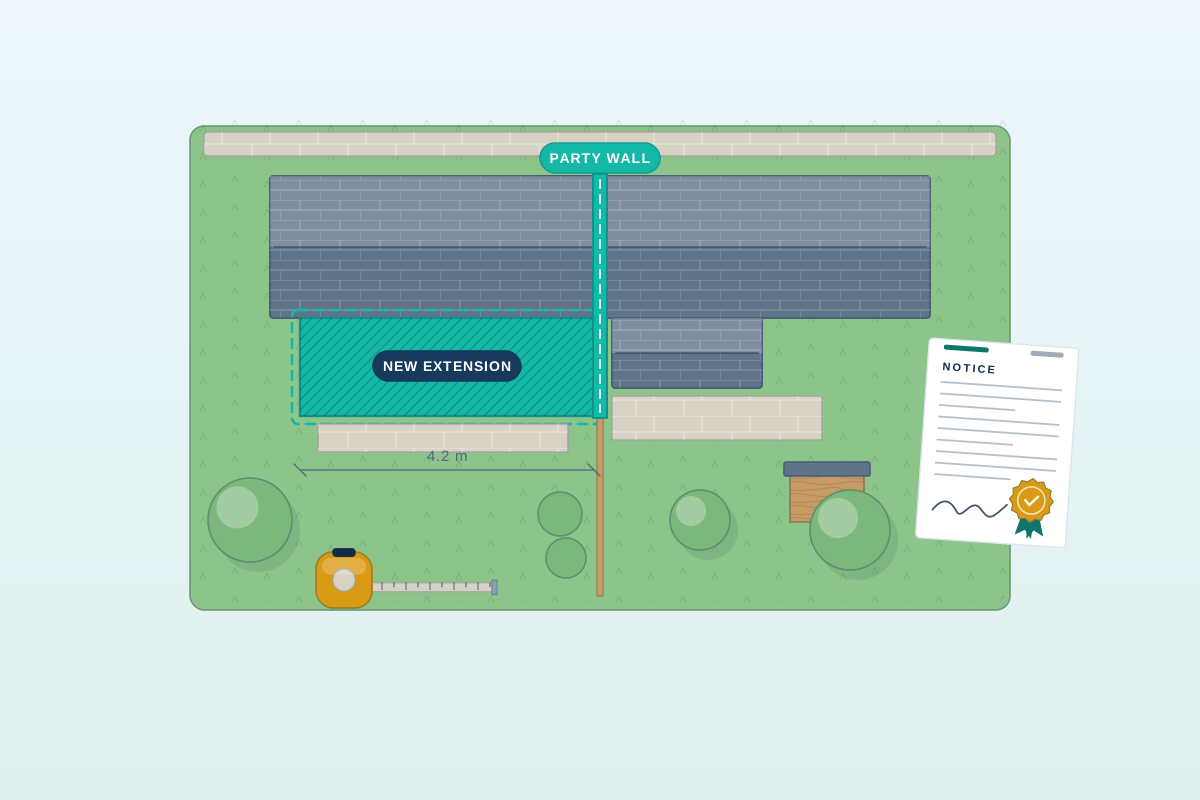
For homeowners in England and Wales building next to a neighbour, on the boundary or close to their foundations. Compare quotes from party wall surveyors before the groundworks begin.
An extension often comes right up to the boundary. A side return extension may put a new wall on or against the line, a rear extension may dig foundations alongside the neighbour’s house, and either may cut into a shared wall to tie in. In England and Wales the Party Wall etc. Act 1996 deals with each of these through different notices: a line of junction notice for a new wall on the boundary, a notice of adjacent excavation for digging near the neighbour’s foundations, and a party structure notice if you are working on a shared wall. A party wall surveyor works out which apply to your design and serves them in good time.
How a professional can help
- Working out which notices apply: Comparing the plans with the Act’s triggers: building at or across the boundary, digging deeper than and close to the neighbour’s foundations, or cutting into a shared wall. Many extensions need more than one notice.
- Foundations next to the neighbour: Reviewing the engineer’s foundation design, depth and distance from next door, and writing sensible protection, sequencing and monitoring into the award where the digging is close.
- Side return and boundary walls: Where a new wall will be built up to or across the line, the notice and award record which side it sits on, how it is built and how flashings against the neighbour’s wall are dealt with.
- Recording the house and garden next door: A schedule of condition of the nearest walls, ceilings, patio and outbuildings records what is there before the digger arrives, so you and the neighbour both have a clear record.
- Tying into an existing shared wall: If the extension attaches to a wall you share, for example the wall between two terraced houses, the surveyor covers the cutting-in and the weatherproofing details that affect the neighbour.
- Terms for the groundworks: If your neighbour objects to a party structure or excavation notice, or does not reply, the surveyors set terms for digging, working hours, protection of paths and drains, and access, so building can start on fair rules.
Is this right for you?
- You plan a rear, side return or wraparound extension that goes up to or near the boundary with a neighbour.
- Your engineer’s foundations are close to, or deeper than, the neighbour’s.
- You are adding a garage, utility or annexe at the side of the house, built right up to the boundary.
- You have planning permission or permitted development rights and your builder wants notices in place.
How the project usually runs
- Walls and foundations fixed: Your designer and structural engineer fix the position of new walls and the depth of foundations, because the notices depend on what is built where and how deep the excavation goes.
- Notices go out with drawings: Each notice goes to the neighbour with your drawings. A line of junction or excavation notice needs at least one month, and notice for work to an existing shared wall at least two. Several may be needed together.
- Response and surveyors: A consenting neighbour may need nothing more. If a neighbour objects (dissents) to a party structure or excavation notice, or stays silent for 14 days, an agreed surveyor or two surveyors set terms in an award. A line of junction notice works differently: without consent, you build wholly on your own land.
- Record and protect: Surveyors record the neighbour’s house and garden structures. The award covers working hours, protection of the boundary, treatment of drains or paths and how damage is made good.
- Groundworks and build: The builder works to the award, digging in the agreed order. Once the shell is up, the surveyors can revisit the neighbour’s property and agree any making good, such as paths or paving.
What affects the cost
- How many types of notice your extension needs: line of junction, adjacent excavation, party structure, or a combination.
- How many neighbours the extension touches, such as one side or both.
- How close and how deep the new foundations are in relation to the neighbour’s.
- Whether the neighbour consents or an award has to be agreed, which adds surveyor time before groundworks.
- How much needs recording next door: the house, garden walls, patio and outbuildings.
Planning, Building Regulations and the Act
- The Party Wall etc. Act 1996 applies to extensions in England and Wales. Scotland and Northern Ireland have different rules, so seek local advice there.
- Planning permission, permitted development rights and Building Regulations are separate from party wall rights. Having planning does not mean the neighbour has been notified.
- Foundation depth and type depend on the ground, nearby trees and drains. A structural engineer usually designs them, and building control normally needs the calculations.
- Extension rules differ by nation and council: permitted development limits and Building Regulations vary across England, Scotland, Wales and Northern Ireland. Party wall surveyors work across the UK.
Questions people ask
Do I need a party wall notice for a rear extension?
Often, yes, in England and Wales, if the foundations are close to the neighbour’s and deeper than theirs, or the new wall is on the boundary. A detached house well away from the boundary may not. A party wall surveyor can tell from the plans.
What is a line of junction notice?
It tells a neighbour you plan to build a new wall at or across the boundary, where their land is not already built on at that line. It is served at least one month before work starts. Your surveyor can say whether it applies to your side return or garage.
Can I build up to the boundary without the neighbour’s permission?
On your own land, yes, once the right notices are served, because the Act does not give a neighbour a veto over work it allows. Building across the line is different and needs their agreement. Your surveyor can say which notices your design triggers.
What if the boundary position is disputed?
The Act does not decide who owns what. If you and your neighbour disagree on where the boundary runs, that needs separate advice, perhaps from a boundary surveyor, before notices are served on the basis of one view.
Do I need an award if my neighbour consents?
No. If the neighbour consents in writing to the notice, work can go ahead under it without an award. Many building owners still ask for a schedule of condition so both sides have a record of the neighbour’s house.
How close do I have to dig before the Act applies?
In general terms the Act covers digging within three metres of a neighbouring building that goes deeper than its foundations, and in some cases within six metres, depending on the depth. Your engineer’s drawings let a surveyor apply the exact test for your site.
Available across the UK
Party wall surveyors cover the whole of the UK. The Party Wall etc. Act 1996 applies in England and Wales; Scotland and Northern Ireland have different rules, and a professional can tell you what applies to your property.
- Get free quotes
- Line of Junction Notices
- Notices of Adjacent Excavation
- Rear Extensions
- Single-storey Extension Structural Design
- Party Fence Walls
- Party Wall for Basements
- Party Wall for Beams and Padstones Cut Into the Wall
- Party Wall for Chimney Breast Removal
- Party Wall for Demolishing Shared Structures
- Party Wall for Loft Conversions
- Party Wall for New Builds on the Boundary
- Party Wall for Piling and Deep Excavation
- All services
- Find your area