Change your approved plans or planning conditions
For anyone whose design has moved on since planning was granted. Compare quotes from professionals who can advise on the right route, from a non-material amendment to a Section 73 application.
Designs often change after planning permission is granted: you want a bigger window, your builder suggests a different roof, a structural engineer moves a wall, or a condition turns out to be impractical. Building something different from the approved plans without permission risks enforcement, so the change needs approving first. The route depends on how significant it is. Small changes may be accepted as a non-material amendment, while larger ones, or changes to the wording of a condition, usually need a Section 73 application in England and Wales, with equivalent procedures elsewhere. A good professional judges which route fits, prepares clear before-and-after drawings, and explains the change in planning terms.
How a professional can help
- Choosing the right route: They compare your change with the approved scheme and advise whether it’s likely to count as non-material, needs a Section 73 application, or is different enough to need a fresh planning application.
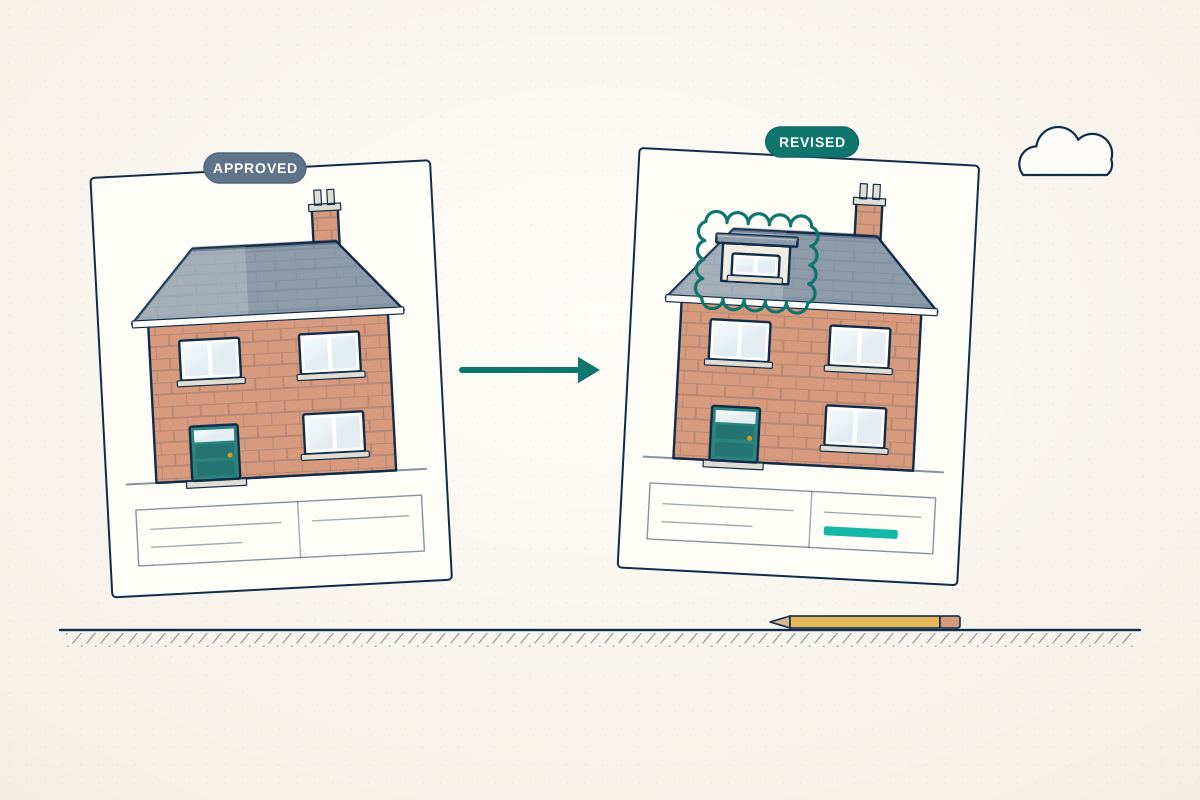
- Before-and-after drawings: They prepare revised plans and elevations that show clearly what has changed, often with the changes highlighted, so the planning officer can compare them with the approved scheme at a glance.
- Rewording or removing a condition: If a condition is unworkable, such as a restriction on use, opening hours or materials, they make the case for varying or removing it, based on planning policy and the facts of your site.
- Carrying everything across: Because a Section 73 approval is a new permission, they check that conditions already discharged, and any legal agreement, still apply properly to the new decision.
- Talking to the planning officer: Where it helps, they discuss the change with the council before submitting, and respond to any concerns or neighbour comments while the application is being decided.
Is this right for you?
- You have planning permission but want to change the design, size, windows, materials or layout before or during the build.
- A condition on your permission is stopping you from using the property the way you need to.
- Your builder has started and something on site already differs from the approved drawings.
- You’ve bought a site with permission and want to improve the approved scheme without losing it.
How the project usually runs
- Compare with the approval: Your professional reviews the decision notice, approved drawings and conditions, and sets out exactly what you want to change and why.
- Decide the route: Based on the scale and effect of the change, they recommend a non-material amendment, a Section 73 or equivalent application, or a new planning application.
- Prepare drawings and justification: They prepare revised drawings and a short statement explaining the change, its effect on neighbours and the street, and why it remains acceptable in planning terms.
- Council decision: The council assesses the change, sometimes consulting neighbours again, and then approves it, asks for amendments or refuses it with reasons.
- Update the build information: Once approved, the construction drawings, Building Regulations approval and builder’s contract are updated so everyone works from the same version of the design.
What affects the cost
- How significant the change is, and whether it can go in as a non-material amendment or needs a fuller application.
- How many drawings need revising, and whether the approved drawings exist in an editable form.
- Whether supporting reports, such as daylight, heritage or ecology assessments, need updating to reflect the change.
- Whether a legal agreement tied to the original permission also needs to be varied.
- Whether the change is controversial locally, which can mean more correspondence with the council and neighbours.
Amendments and Section 73 applications
- In England and Wales, non-material amendments are made under Section 96A and changes to conditions under Section 73. Scotland and Northern Ireland have their own equivalent procedures.
- There’s no fixed definition of “non-material”: it’s for your council to judge in the context of the whole permission.
- A Section 73 application can’t usually extend the time limit for starting work or change the description of the development.
- Building to a different design before the change is approved can lead to enforcement action, so apply before you build.
Questions people ask
What counts as a non-material amendment?
It’s a change small enough that it doesn’t alter the substance of what was approved, such as moving a window slightly or a minor change of material. There’s no fixed list, and councils judge each case in context, so a change that is non-material on a large scheme might be material on a small house. Your professional can advise how your council is likely to see it.
What is a Section 73 application?
In England and Wales, it’s an application to carry out development without complying with, or with changes to, conditions on an existing permission. Because the approved drawings are usually listed in a condition, it’s also the usual way to approve larger design changes, sometimes called a minor material amendment. If approved, it creates a new permission alongside the original one.
Will my neighbours be consulted again?
For a Section 73 application, usually yes, in much the same way as a normal planning application. In England, non-material amendments often aren’t publicised, although the council can choose to consult. Either way, it helps to think about how the change affects neighbours and to explain it clearly in the application.
Can I change the approved plans after building work has started?
Yes, but apply as soon as you know about the change. If the work already differs from the approved drawings, you may be applying retrospectively, and the council could take enforcement action if it doesn’t accept the change. Keep your builder, building control and any lender or warranty provider informed too.
Is it ever better to make a new planning application instead?
Sometimes. If the changes are substantial, alter what the development actually is, or the original permission is close to expiring, a fresh application may be cleaner and gives you a new set of conditions. Your professional will weigh the planning risk, the paperwork and the effect on any existing legal agreement before recommending a route.
Available across the UK
Professionals cover the whole of the UK: England, Scotland, Wales and Northern Ireland. Planning and Building Regulations differ between the four nations, and your professional will work to the rules that apply where your property is.
- Get free quotes
- Discharge of Planning Conditions
- Retrospective Planning Applications
- Planning Drawings
- Planning Consultants
- Change of Use
- Conservation Area Projects
- Design and Access Statements
- Full Planning Applications
- Heritage and Conservation Architects
- Heritage Statements
- Householder Planning Applications
- All services
- Find your area