Monitor cracks over time to see whether your building is still moving
For owners, buyers and insurers who need evidence of whether movement is continuing, slowing or has stopped. Describe the cracks and compare quotes from engineers who fit gauges and take readings.
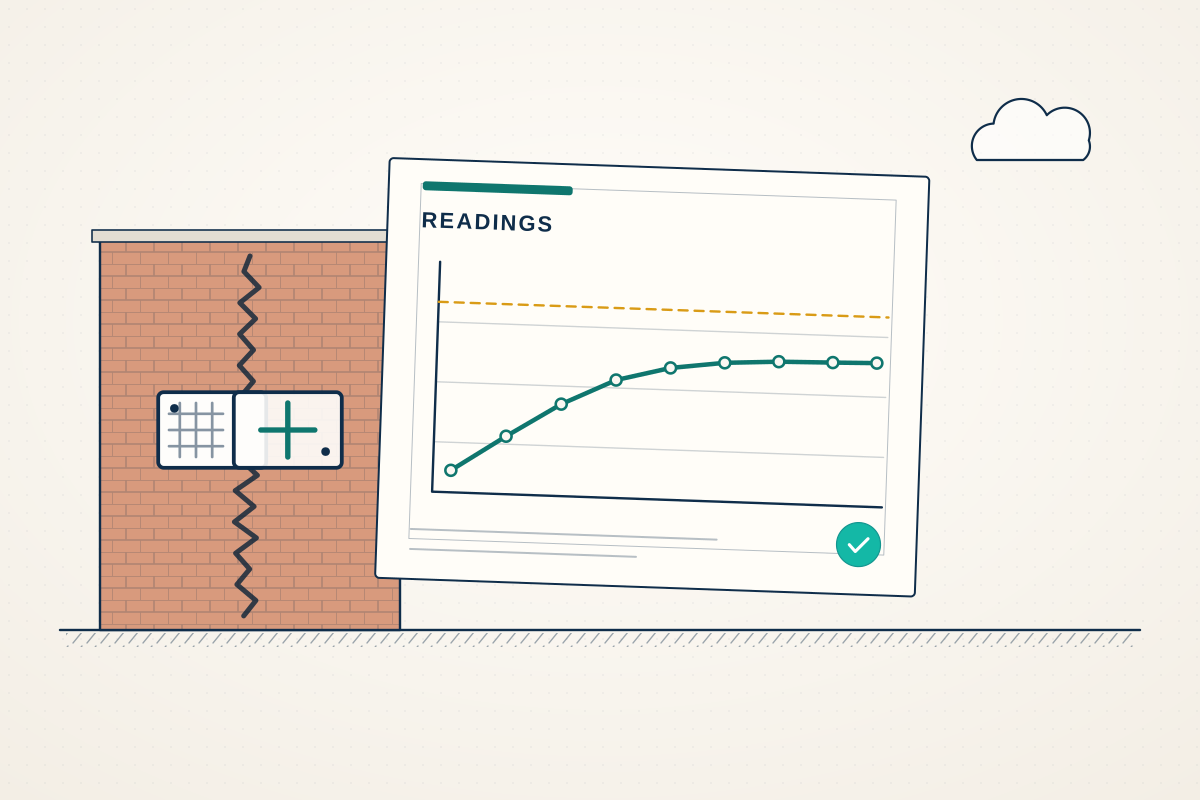
A crack on one day shows how wide it is, but it does not show whether it is opening, closing or stable. Crack and movement monitoring answers that by measuring over time. Simple gauges are fixed across the cracks, small studs are fixed to the walls to record levels, and readings are taken at regular intervals over several months, ideally long enough to see how the building responds to the seasons. The pattern tells an engineer whether movement is seasonal, progressive or has stopped, and so whether a repair is needed. Monitoring before repair is the usual approach where subsidence is suspected, and it is often what an insurer or lender asks for.
How a professional can help
- Fitting crack gauges: Tell-tale gauges, usually two overlapping plastic plates marked with a grid and cross-hairs, are fixed either side of a crack. They show opening and sideways movement, and can be read by eye.
- Level monitoring: Studs or marks are fixed at set points on the walls and their heights are measured against a fixed reference point, so any settlement or lift of one part of the building compared with another can be seen.
- Readings at set intervals: Readings are taken at regular, agreed intervals, with dates and notes recorded, so each reading can be compared with the last one and with the starting point.
- Electronic and logged monitoring: Where a more detailed record is useful, electronic sensors can log movement automatically, which suits cracks that change quickly or places that are hard to visit often.
- Reading the results: Charts of the readings are studied for seasonal opening and closing, steady movement in one direction, or no change at all, and the engineer explains what each pattern suggests.
- A report you can use: A report with the readings, charts and a conclusion can go to your insurer, lender, buyer or builder as evidence of whether movement has stopped or is continuing.
Is this right for you?
- An engineer, surveyor or insurer has said monitoring is needed before any repair is decided.
- You have cracks that seem to come and go with the weather and want to know whether they are active.
- You’ve had repairs, underpinning or tree work and want evidence that movement has stopped.
- You’re buying or selling a property with a history of movement, and need a clear record.
How the project usually runs
- Survey and starting point: The engineer records the cracks, photographs and measures them, notes their positions and chooses where to fix gauges and level studs, so the readings start from a known baseline.
- Installing the monitoring: Gauges are fixed across the cracks, and level studs and a reference point are set. Each is numbered on a plan, and you are asked not to disturb, paint over or remove them.
- Regular readings: Readings are taken at agreed intervals over several months, either by the engineer or a technician, or by you to a simple schedule, with the date recorded each time.
- Review of the results: The readings are charted and compared with the seasons and the weather, and the engineer reviews them at set points to see whether movement is increasing, slowing or settled.
- Conclusion and next steps: A final report says whether movement is seasonal, progressive or has stopped, and recommends whether to repair, keep monitoring or leave the building as it is.
What affects the cost
- The number of cracks and level points being monitored.
- How long monitoring runs, and how often readings are taken.
- Whether the engineer or a technician takes the readings, or you take them to a schedule.
- Whether simple gauges are enough, or electronic sensors or precise level surveys are needed.
- How easy it is to reach the cracks, including high, outside or shared walls.
- Whether an interim report is needed for an insurer or lender before monitoring finishes.
Insurers, neighbours and the UK nations
- If your insurer, lender or buyer has asked for monitoring, ask what period, how many readings and what format they will accept before any gauges go on. Monitoring done to the wrong specification may have to be repeated.
- Gauges and readings work the same way wherever you live, but approval for any repair that follows does not. It differs across England, Scotland, Wales and Northern Ireland, with a building warrant in Scotland. Engineers cover the whole UK.
- On a listed building, or on a shared or leasehold wall, check with the owner or the council before fixing anything to the walls.
- If building work is planned next door, a schedule of condition prepared as part of the Party Wall etc. Act 1996 process records the starting point in England and Wales. Monitoring is a separate, additional measure.
Questions people ask
How long does monitoring need to run?
It depends on the building and why it is being monitored. Where subsidence is suspected, it usually runs for several months so that it covers some seasonal change, and sometimes longer. A short period can mislead, because many cracks move with the seasons. The engineer will advise on the period when the gauges are set.
Why do the readings go up and down?
Many cracks open a little in dry or warm weather and close again when it is wet or cool, so readings rise and fall with the seasons. Small differences can also come from how a gauge is read. The engineer looks at the trend across the months, not one reading, to see whether movement is seasonal, steady or has stopped.
Can I take the readings myself?
Often yes, for simple gauges, if the engineer gives you a clear schedule and a form. Accurate recording matters, so photograph each reading and note the date. If an insurer or lender needs the results, check they will accept readings taken by you. Level readings and electronic sensors are usually taken by a technician or engineer.
What if the crack grows during monitoring?
Tell the engineer straight away rather than waiting for the next scheduled reading. They may bring a visit forward, add readings or advise on action. If you notice sudden movement, such as a fast-opening crack or a bulging wall, ask for advice at once and keep people clear of the area.
Will monitoring tell me what is causing the movement?
Not on its own. It shows how and when the building moves, which points towards causes such as seasonal clay movement or a continuing problem. Combined with trial pits, drain checks and a look at the trees, the picture becomes much clearer, which is why monitoring is often part of a wider investigation.
Available across the UK
Professionals cover the whole of the UK: England, Scotland, Wales and Northern Ireland. Planning and Building Regulations differ between the four nations, and your professional will work to the rules that apply where your property is.
- Get free quotes
- Cracks and Movement Investigations
- Subsidence Investigations
- Vibration Monitoring Near Construction
- Schedules of Condition
- Bowing, Leaning and Bulging Wall Assessments
- Chimney Stack and Parapet Stability Checks
- Expert Witness and Defect Investigations
- Fire, Flood and Impact Damage Assessments
- Historic and Listed Building Structural Surveys
- Independent Second Opinions and Design Checks
- Independent Structural Advice for Neighbours
- All services
- Find your area